
- Early development
- Collaborative and conceptual development
- Content and aesthetic development
- Technology development
This page outlines current and ongoing development beyond the doctoral research concluded in September 2023. That earlier research and development is fully documented in the PhD Visual Journal (pdf document), which is itself a capture of the interactive on-line document stored at Visual Journal [milanote].
Early development
The following are projects that strongly informed, or were important milestones, in the development research:
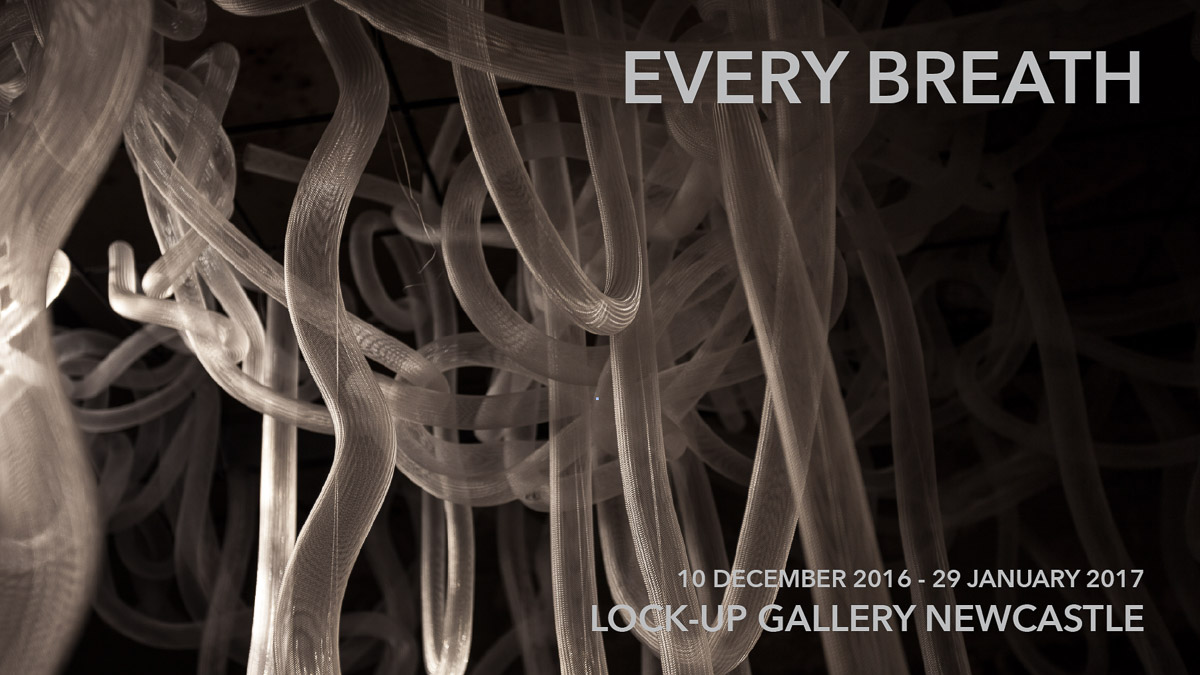
Every Breath exhibition (2016)
A curated exhibition with 12 artists and scientists using air and breath as a means of connecting an audience with earth’s systems.
This and the next 2 projects are essentially about ‘connectedness’; a precursor to system thinking.

Catch Your Breath (2016-present)
A device for capturing a breath as a bubble in a water tank using high-speed flash photography and sharing the image with others.

Life Support System (2016)
A simplistic but effective political animated and interactive representation of the three competing systems of economics, humanity and nature and their interactions.
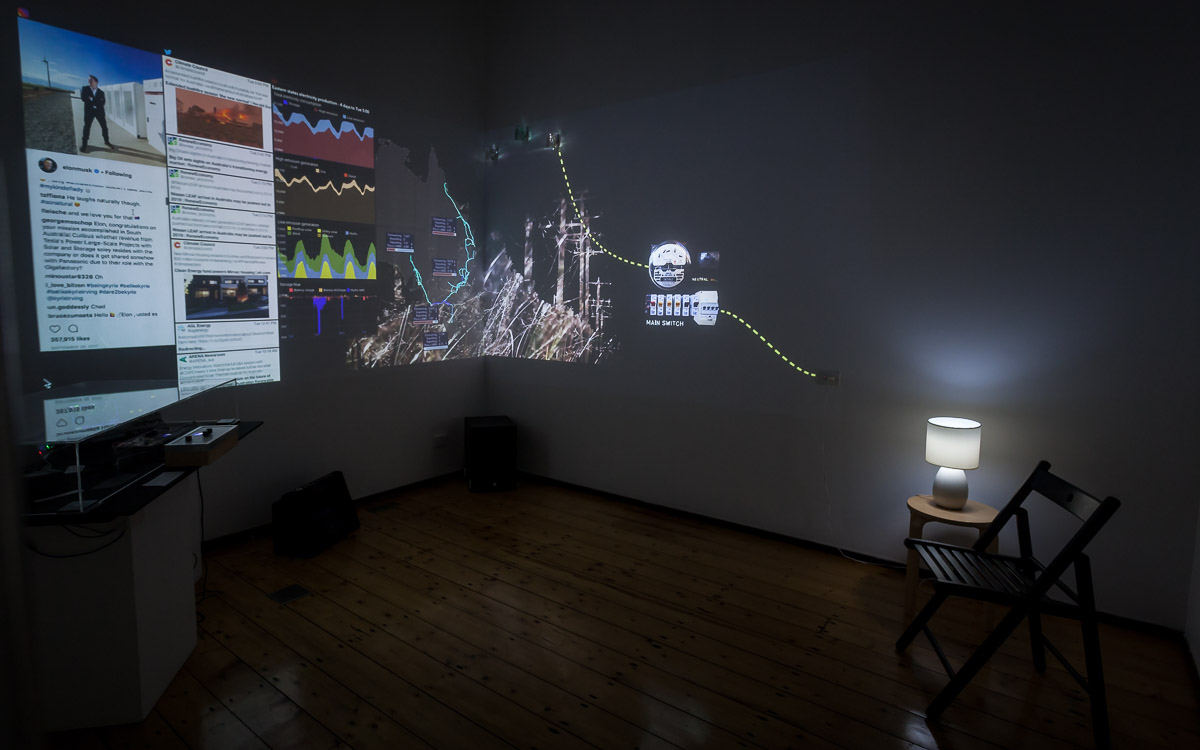
Hum (2018)
Exploration of the electricity grid as a human system in rapid transition and influenced by systems of economics, politics and technology
You Are Here 0.2 (2020)
Original concept of You Are Here as a visualisation of the journey of individual human breaths around the globe; their connection with atmospheric movement and related connection with atmospheric water and rainfall; contrasted with national borders restricting human motion. (This video shows the path of a single breath).
Collaborative and conceptual development
System thinking involves listening to all the ‘voices’ that make up the system – human or non-human (for discussion see chapter 2 – summary in section 2.4 – of the research thesis [ref 1]). This implies the following conceptual requirements for the You Are Here project:
- any single creative practitioner cannot be sensitive to all of the potential ‘voices’. The project should be collaborative and include the work of other artists and scientific and cultural researchers with diverse analytical and expressive skills, knowledge and sensitivities.
- different ‘voices’ may have different ways of organising the world into systems (ontologies) or different ways of coming to understand the world (epistemologies); e.g. indigenous cultures. The You Are Here platform has developed tools such as assemblages, elements, and system associations intended to respect diverse ontologies (sections 3.2 and 3.5.2 of the thesis [ref 1]).
- collaboration may range from contributing content for representation on the platform, to an expanded transdisciplinary research with a question of ‘how do we incorporate a specialised system knowledge in a way that helps an audience sense the relationships between the social, biological and physical systems of the earth?’ Collaboration may also be curation – helping to select and structure content to best convey the world’s complexity. (Refer section 3.4 of the thesis [ref 1])
- to facilitate these requirements the platform has been developed in the Unity3D software environment using a modular approach to simplify adding and organising content, a standardised set of representational formats, interoperability across contributors and their contexts, and ultimately an open-source platform (section 3.3.2 of the thesis [ref 1]).
- while the project is framed around geospatial – ‘mapped’ – content it also recognises that not all systems, experiences or values can be quantified and mapped, particularly human systems. “The map is not the territory” as Korzybski stresses. This limitation is minimised by the inclusion of artistic approaches to systems thinking, i.e. the ‘experiential’ content such as the paths of human breath (section 3.3.2 of the thesis [ref 1]).
The value of the project in fostering system thinking depends on the contribution of a diverse group of collaborators, not only in representing diverse voices but also testing and improving the assumptions and limitations outlined above. Steps have been taken in developing these collaborations through approaches to researchers, for example an affiliation with the ‘complexity group’ of researchers working in the complex system space in multiple disciplines across the University of Newcastle.
Content and aesthetic development
The following are currently in development:
– prototype templates for representing different data formats, e.g. linear and point elements, including their audio features
– interaction elements for navigating within the platform or activating content
– implementing a particular system visualisation, e.g. systems of electricity infrastructure, to exemplify these templates and elements
The objective is a unifying aesthetic across all content and a small set of interaction elements that are intuitive to operate. The challenge is to balance the tendency to represent content as a tool for analysis of a system against the project objective to make visible the patterns of relationships and behaviours across systems, i.e. to sense rather than analyse.
Electricity system example
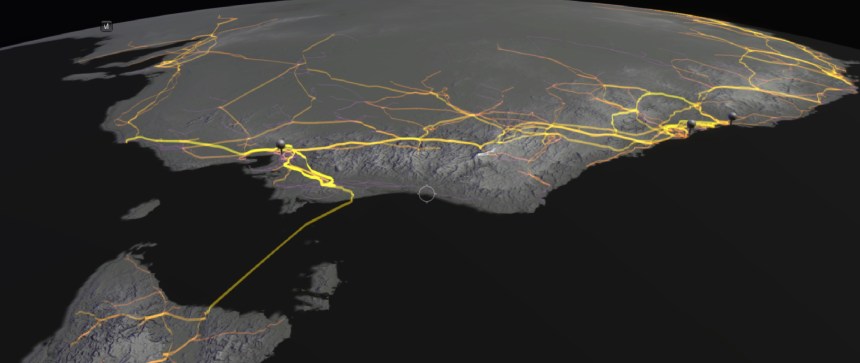
The line and point form of the electricity network and generation stations are a model for many other system representations: settlement and transport networks of human population; agricultural production, processing and food distribution networks; or migration routes and breeding and feeding grounds of animals. Elements of many systems may have recognisable audio attributes that could be activated by proximity to that element, e.g., the hum of an electricity cable, or the sound of wind turbines.


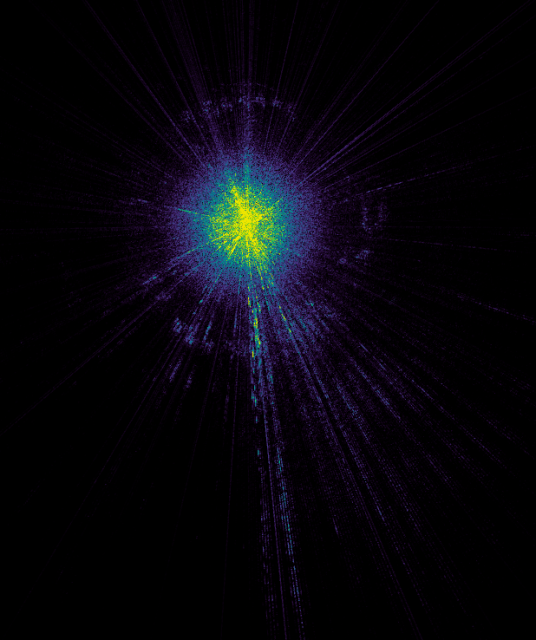
The Soundings (2024) project explored ambient and hydrophone recordings of a place as a means of taking an audience to an otherwise inaccessible location. The technology and tools developed are applicable within You Are Here as a form of ‘audio portal’, probably used alogside the spherical portal.
Technology development
There are currently three key technology development strands.
1. The development of a prototype data server (see following diagram) that will interpret, store and serve, in real-time, re-formatted data from public and collaborator data sources and remote sensors for use by distributed instances of the You Are Here installation.
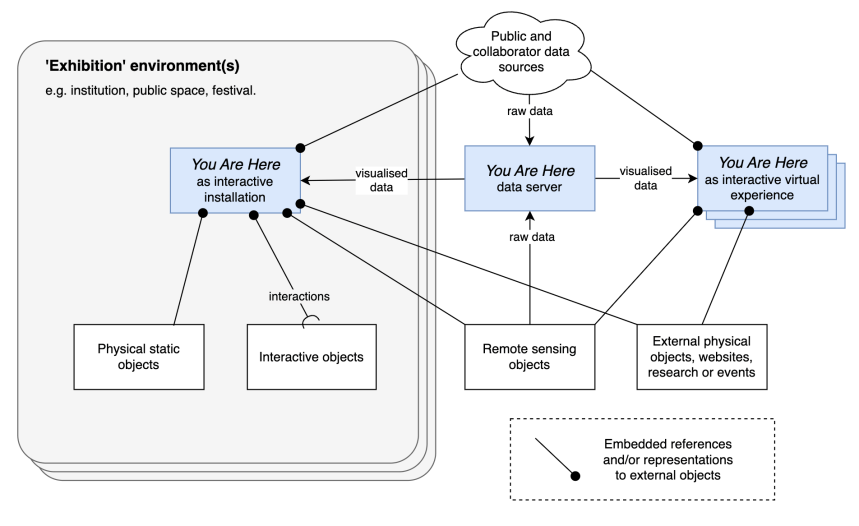
2. The further development of a simple gestural user interface for interaction with the work. Currently a touchpad allows simple one- and two-finger gestures to control all aspects of the interaction. To be applied in diverse installation environments this needs to be translated to other interfaces, such as non-touch spatial or touch-screen technology.

3. The development of a temporal capability. Complex systems are constantly in flux – the state at any point is time is dependent on the dynamic changes that occurred prior to that time. The rainfall here now arises from earlier evaporation elsewhere, the present state of indigenous peoples is a result of past colonial forces. Some temporality can be implied by the flow evident in a static visualisation, but others are best visualised by dynamic content that shows change over periods of time – hours, decades or millennia.
References:
[1] This is the PhD thesis and a large pdf file. It is best downloaded and referenced manually Doctoral Exegesis – Andrew Styan – University of Newcastle
 Andrew Styan