
Introduction
The ecological and social challenges we face are not simple cause-and-effect problems with simple solutions. They are the result of the action over many decades of all the complex interactions of the entangled social, biological and physical systems that make up our world. Solving them requires ‘system thinking’ – the recognition that we are part of those systems, the understanding of how those systems interact, and how to influence them while avoiding undesirable side effects. Western cultures don’t encourage us to think this way. To start addressing this deficiency psychologist Renee Lertzmann calls for an “expanded cognitive capacity to see ourselves as embedded in the system” and sociologist Bruno Latour calls for us to “sensitise ourselves to the earth”, that is, to become responsive to the stimuli of the whole-earth system.
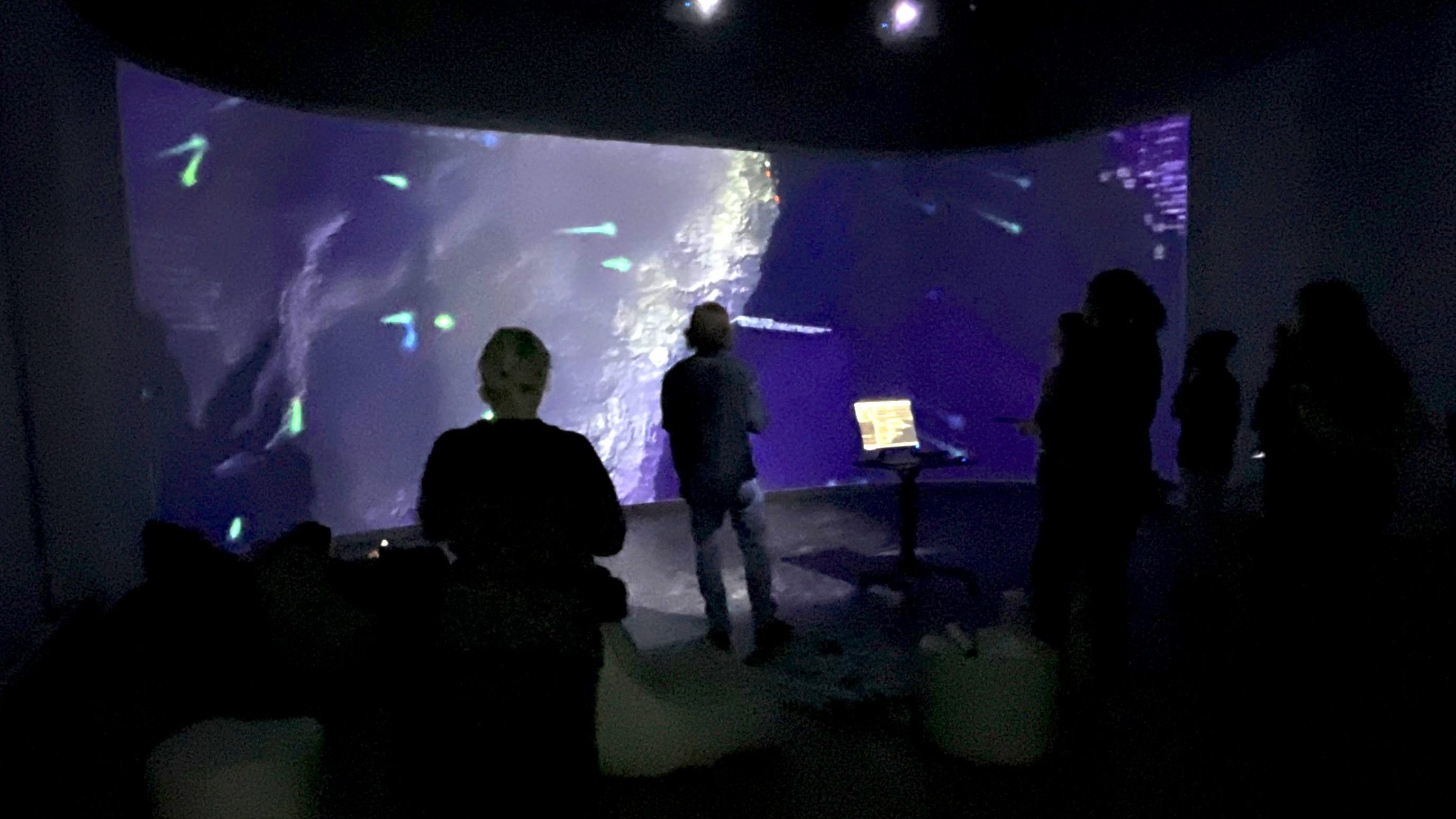
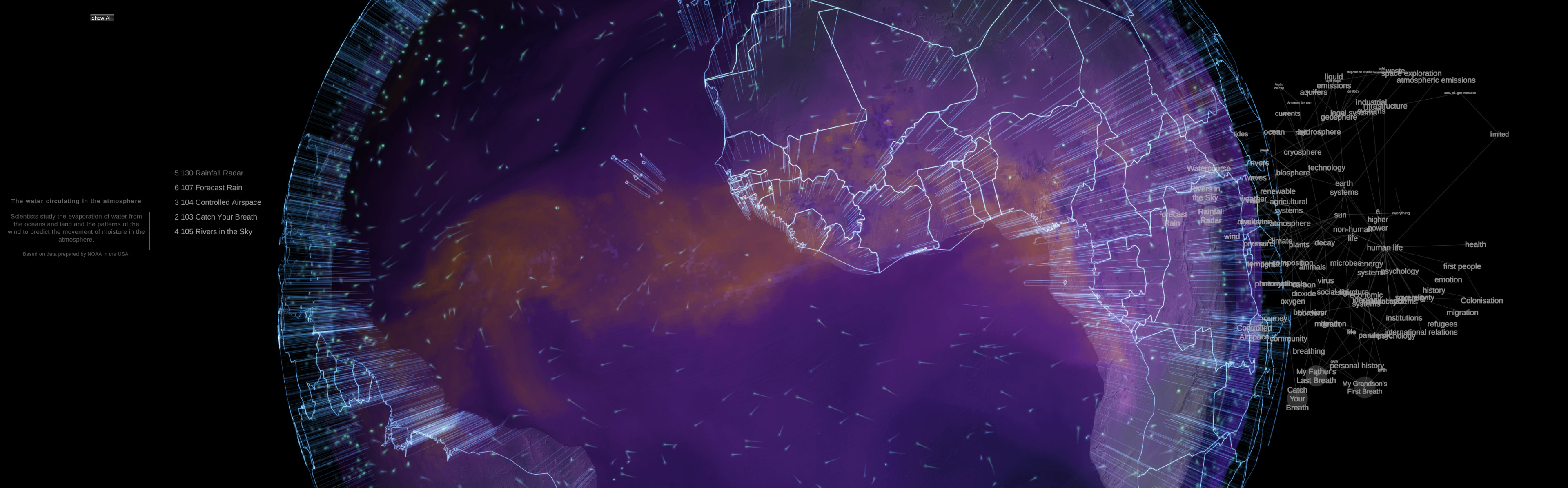
One approach supporting this is suggested by system theorist Donella Meadows’ call to “listen to what the system tells us”. The You Are Here project takes this literally by immersing the audience within representations of the earth’s systems in an interactive digital media environment. Adopting an astronaut perspective the participant explores 3D geospatial data visualisations of the earth’s social, biological and physical systems. This content can be sourced from any relevant scientific, cultural or arts research and is curated, structured and activated in a way that the participant can create a personal narrative as they navigate the various visualisations. Just as we sensitise ourselves to our local and social worlds as we navigate our daily lives, the experience of You Are Here is intended to expand that sensitivity by navigating the normally invisible systems behind those same worlds (for conceptual discussion see section 3.1 of reference 1).

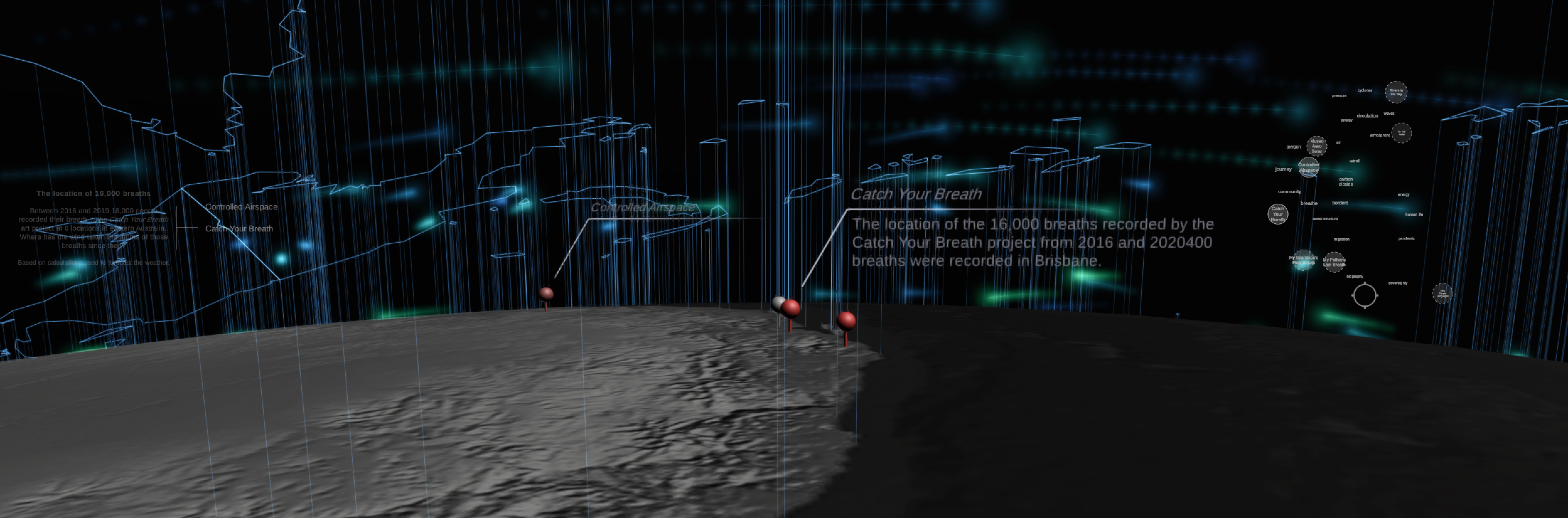
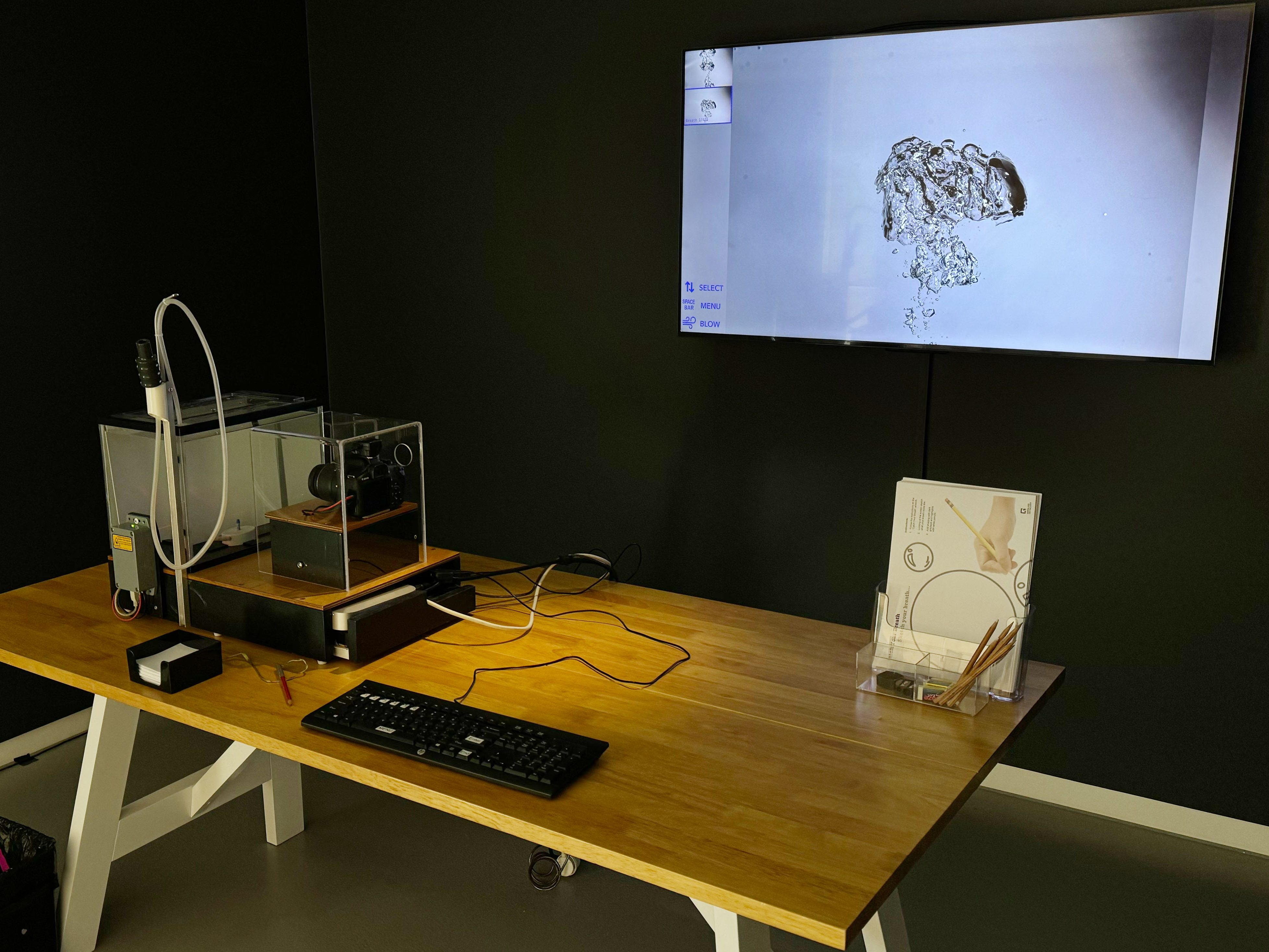
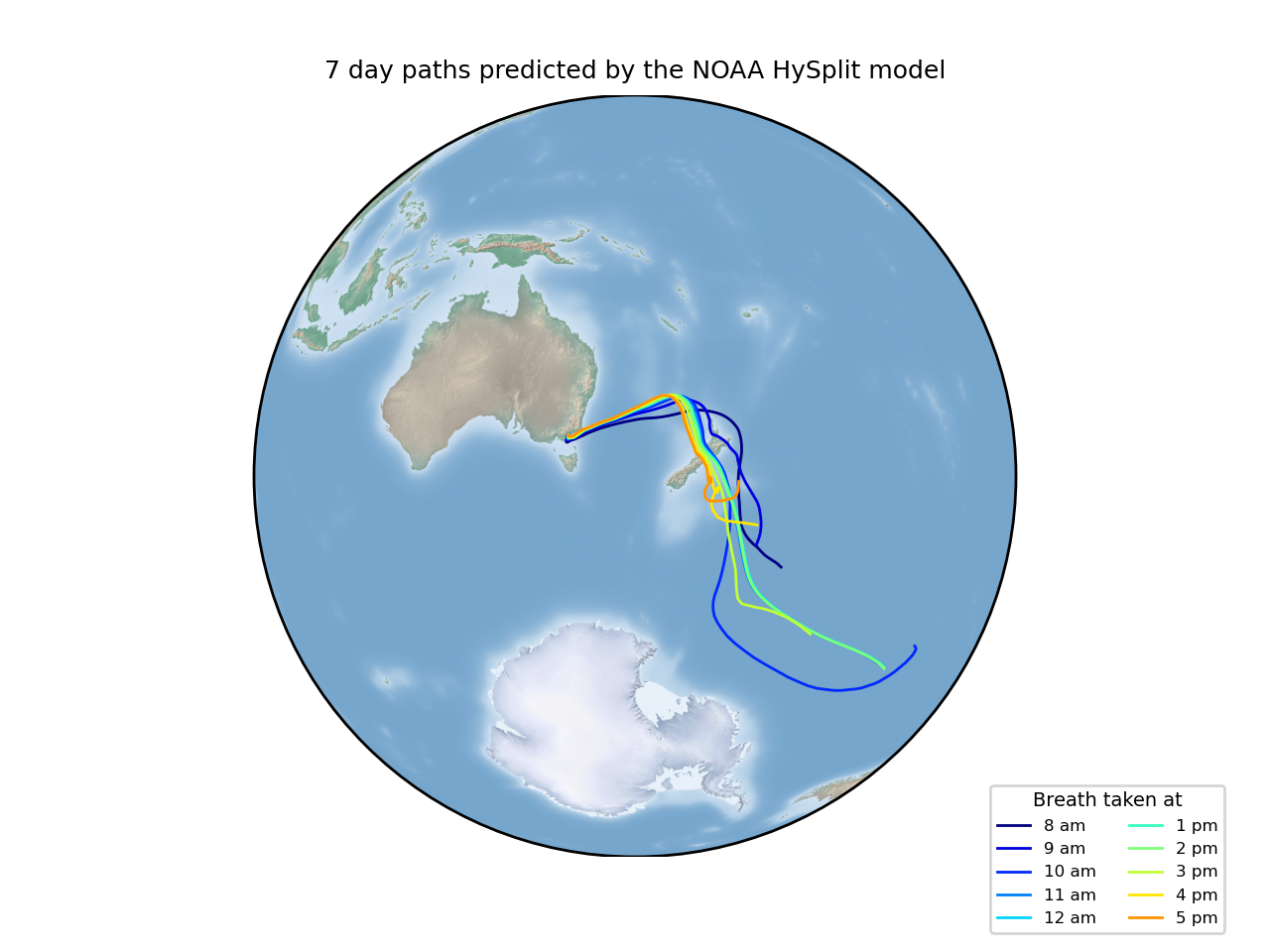
To evoke an emotional and human connection with the earth systems data visualisations, additional visualisations based on lived experience are incorporated. For instance the scientifically modelled journey through the atmosphere of individual breaths, such as my father’s last breath, or the current location of the 19,000 breaths recorded since 2016 by the interactive art installation Catch Your Breath (2016-) that sought to engage the audience in the act of breathing. These representations draw on our ’embodied knowledge’ of the breath and connect it with global scale systems and the idea that we share the same air. Taking this further, in the next version of Catch Your Breath each breath will become in real time a new trace in the atmosphere of the You Are Here platform.
How these concepts are integrated may best be understood through screen-capture videos:
1. Demonstration with a participant passively observing – YAH passive mode
2. Demonstration with a participant actively interacting – YAH active mode
These videos are captioned (in yellow) for demonstration purposes to describe the actions, content and tools. They are best viewed on a laptop or larger screen due to the wide format. Audio is under development.
The images below show two installation views and more detail of the various aspects of the project.

Project status
The project is the creative outcome of PhD research at the University of Newcastle conducted between 2017 and 2024. That research also developed a set of art practice principles for system thinking that were applied in the You Are Here platform as it was developed (see section 2.4 of reference 1).
Completed to a working proof-of-concept stage, the following seven contents were included:
1. visualisations of the location of 5,000 of the breaths recorded by Catch Your Breath (modelled using atmospheric models)
2 & 3. animated journeys of my father’s last breath and my grandson’s first breath (as above)
4. distribution of water in the atmosphere influenced by the atmospheric motion behind the breath visualisations (from climate data)
5 & 6. forecast rainfall (from climate data) and the actual rainfall (from global rainfall radar) distributions
7. national borders projected into the atmosphere
Further project development is on three critical dimensions:
- Expand the planetary content: the proof-of-concept content is limited in scope and only partially represents the cycles of water, atmospheric motion, life and geopolitics. This is insufficient to give the audience any sense of the totality of the earth’s systems as that would require many other systems and cycles – carbon, oxygen, energy, nutrient, plant and animal life, human systems such as communication, influence, capital, agriculture, trade and settlement might all be expected. Project development is concentrating on including this type of content for a more complete perspective and is a prerequisite to a public release, although there may be focussed releases that more fully explore the system connections of breath, for example.
- Expand the range of expressive content: as we move from physical to biological to social systems there is increasing difficulty in representing these systems through quantifiable data and visualisations. They become more qualitative, more difficult to model and measure, and, ultimately, impossible to represent in a geospatial data form – they can’t be ‘mapped’. This is offset in the project design by an increasing reliance over this spectrum on artistic representations and not enforcing a rigid system structure; the aim is to leave room for imaginative and emotive interpretations. The evocative notion of ‘My Father’s Last Breath’ is an example.
- Localise the content: the systems based content initially has a planetary basis: the visualisations are of global systems. While this is important for thinking about the world as a ‘globally interconnected system’ this is not the geographic or conceptual scale at which individuals normally relate. We are familiar with and can influence much smaller regions and as the project further develops, localised content will be sourced that helps to think about more local regions within the global context. This might be a city, a valley, or a bioregion – an area naturally bounded by patterns of weather, geography, soil, plant and human communities.
Taken together, these requirements for global and local system representations across many physical to social systems is beyond the capacity of any individual practitioner. An approach is required that includes diverse science, social, cultural and arts participants with understandings across those systems, scales and sensitivities. The platform and development strategy are designed around this collaborative requirement.
The following page on project development expands on these considerations and outlines current activities.
Academic information
An outline of the project, as presented at the 2024 ISEA conference in Brisbane – You Are Here: A system thinking approach for navigating an uncertain future
[reference 1] The theoretical and conceptual research for the project – Doctoral Exegesis – Andrew Styan – University of Newcastle (Sep, 2023)
See also
Acknowledgment:
The PhD research was supported by an Australian Government Research Training Program (RTP) Scholarship.
 Andrew Styan